
1. Core Principle (Kármán Vortex Street)
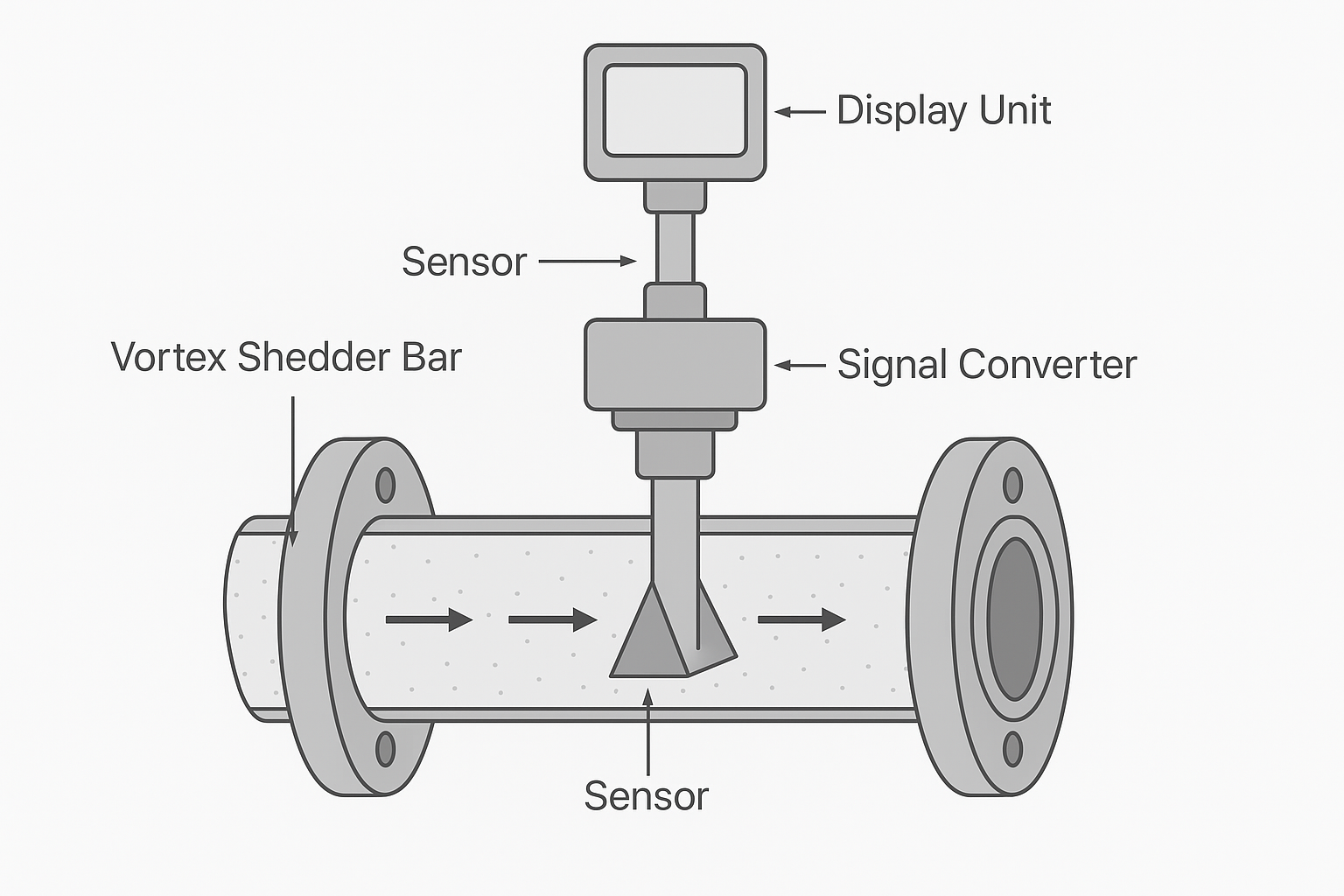
When fluid flows past a non-streamlined vortex generator, alternating vortices are formed on either side, arranged in a regular pattern (Kármán Vortex Street).
Vortex shedding frequency:
: Strouhal number (approximately 0.16–0.22, stable within Reynolds number
to
)
: Fluid average velocity
: Characteristic width of the vortex generator
Flow rate is proportional to frequency:
(where
is the instrument constant)

2. Sensor Structure Overview (Three Key Components)
1. Measurement Tube (Body)
Materials: 304/316L stainless steel, carbon steel, Hastelloy, titanium (selected based on the medium’s corrosion/temperature)
Function: Fluid passage, ensuring stable flow field with smooth inner walls and minimal interference.
2. Vortex Generator (Core)
Main shapes: Triangular (most common, stable Strouhal number, low pressure loss, resistant to interference)
Other shapes: Trapezoidal (wear-resistant, for fluids with minor particulates), Cylindrical (simple, for low-pressure gases)
Key parameter: Blockage ratio (0.2–0.3), balancing vortex strength and pressure loss.
3. Detector (Signal Conversion Core)
There are three primary types that convert vortex pressure/vibration into electrical signals (pulse/voltage):
Piezoelectric (Industrial Mainstream)
Principle: Vortex impacts generate alternating charges in piezoelectric crystals.
Advantages: Fast response time (≤1 ms), high temperature resistance (-20°C to 400°C), compact structure, high signal-to-noise ratio.
Limitations: Sensitive to pipeline vibrations, requires vibration isolation.
Applications: Steam, clean gases/liquids, high-temperature environments.
Capacitive
Principle: Vortex causes changes in the distance between capacitor plates, detecting fluctuations in capacitance.
Advantages: Corrosion-resistant, wear-resistant, better anti-vibration than piezoelectric.
Limitations: Slower response time, optimal performance at low temperatures, higher cost.
Applications: Sewage, chemical waste, fluids with minor particulates.
Ultrasonic (Non-contact)
Principle: Vortex affects the propagation time of ultrasonic waves.
Advantages: No wear, no pressure loss, non-contact with the medium.
Limitations: High cost, vulnerable to medium acoustic impedance and bubble interference.
Applications: High-purity fluids, highly corrosive, ultra-clean environments.
3. Key Technical Parameters (Must-Know for Selection)
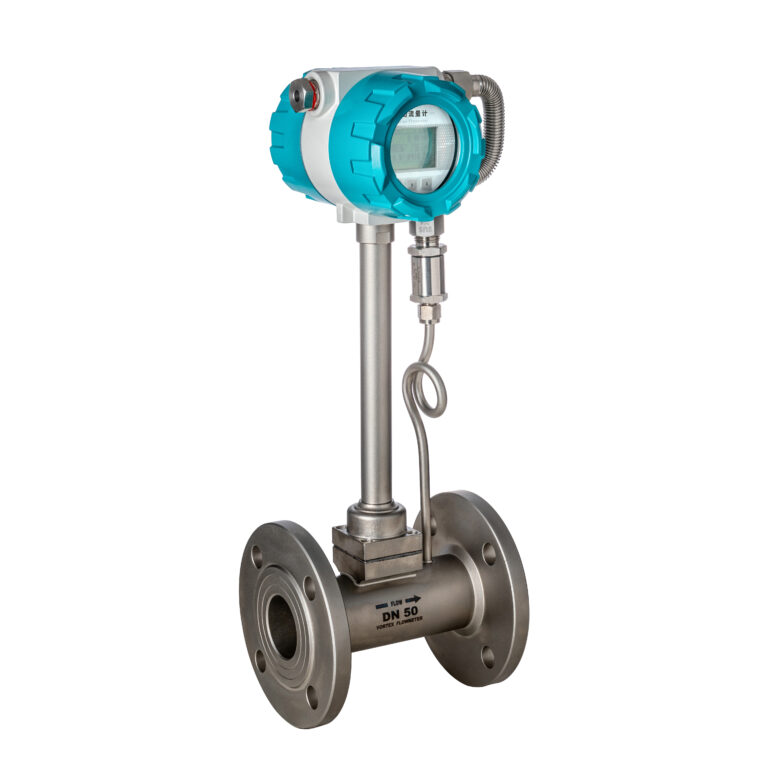
Measured Media: Gases, liquids, steam (not suitable for multiphase/high gas content)
Temperature Range: Piezoelectric: -20°C to 400°C; Capacitive: -40°C to 150°C
Pressure Rating: PN16/PN25/PN40/PN63 (choose based on operating conditions)
Accuracy: Liquid ±0.5% to 1.0%; Gas/Steam ±1.0% to 1.5%
Rangeability: 10:1 to 20:1 (better than orifice plates)
Outputs: Pulse, 4–20mA, RS485, HART
4. Installation & Usage Points (Critical for Accuracy)
1. Straight Pipe Section Requirements:
Upstream: ≥15D (D is the pipe diameter)
Downstream: ≥5D
Avoid interference from valves, elbows, and reducers nearby.
2. Vibration Isolation:
Piezoelectric sensors must be vibration-isolated: use reinforced brackets, flexible connections, and install away from pumps/compressors.
3. Installation Direction:
Liquids: Horizontal/Vertical (fluid flowing upwards), avoid bubble accumulation.
Gases/Steam: Horizontal/Vertical (fluid flowing upwards), avoid liquid accumulation.
4. Avoid Interference:
Install away from strong electromagnetic fields and high-power equipment.
Shield signal wires, use separate conduits.

5. Summary of Advantages & Disadvantages
✅ Advantages
No moving parts, high reliability, and minimal maintenance.
Low pressure loss, wide range, and stable accuracy.
Unaffected by changes in density, pressure, and temperature (volume flow measurement).
Suitable for gas/liquid/steam, offering great versatility.
❌ Disadvantages
Sensitive to vibrations (piezoelectric type).
Inaccurate at low flow rates (Reynolds number < 2×10³).
Not suitable for high-viscosity, high gas content, or highly pulsating fluids.